

🧩 1. States Redefine “Appropriate” Care
Federal law guarantees access to intermediate care facilities for individuals with intellectual disabilities (ICF/IID) services for those who need them. But states like Massachusetts:
- Use biased evaluations to declare ICF/IID “inappropriate”
- Imply that community-based services (HCBS) meet everyone’s needs
- Treat ICF/IID as a last resort, not a valid first-line option
This allows them to deny care while appearing compliant with Medicaid and Olmstead.
🏛️ 2. Courts Defer to Agency “Expertise”
State Superior Courts are required to apply federal law when it is relevant to a case. Under the U.S. Constitution’s Supremacy Clause, federal law takes precedence over conflicting state law. This means that if a case before a Superior Court involves federal statutes, constitutional rights, or regulations, the court must consider and apply federal law even though it is a state court.
However, when families challenge these ICF/IID care denials:
- Courts often defer to state agencies’ clinical judgments—even when those judgments are conflicted or unsupported
- Judges may view ICF/IID care as outdated or undesirable, influenced by decades of deinstitutionalization rhetoric
- Legal standards like “most integrated setting appropriate” are interpreted narrowly, favoring community placement
Result: The law says one thing, but courts uphold agency decisions that contradict it.
💼 3. Administrative Hearings Partisan and Slanted
- The Massachusetts Department of Developmental Services (DDS) controls the evaluation, the denial, and the appeal
- Hearing officers are appointed and paid by DDS
- Independent evidence is dismissed, and families are denied fair process
This creates a closed loop of denial, where legal rights exist on paper but not in practice.
🧠 4. Systemic Bias Against Institutional Care
There’s a pervasive belief—especially among policymakers and some disability rights groups—that institutional care is inherently bad. This ideology:
- Ignores the needs of individuals with severe disabilities and those with IDD and comorbid chronic medical conditions
- Treats ICF/IID as failure, not choice
- Frames advocacy for intensive care as regressive
Even when families present strong legal and clinical arguments, they’re dismissed as “anti-integration.”
🏛️Federal Court May Offer Better Outcomes
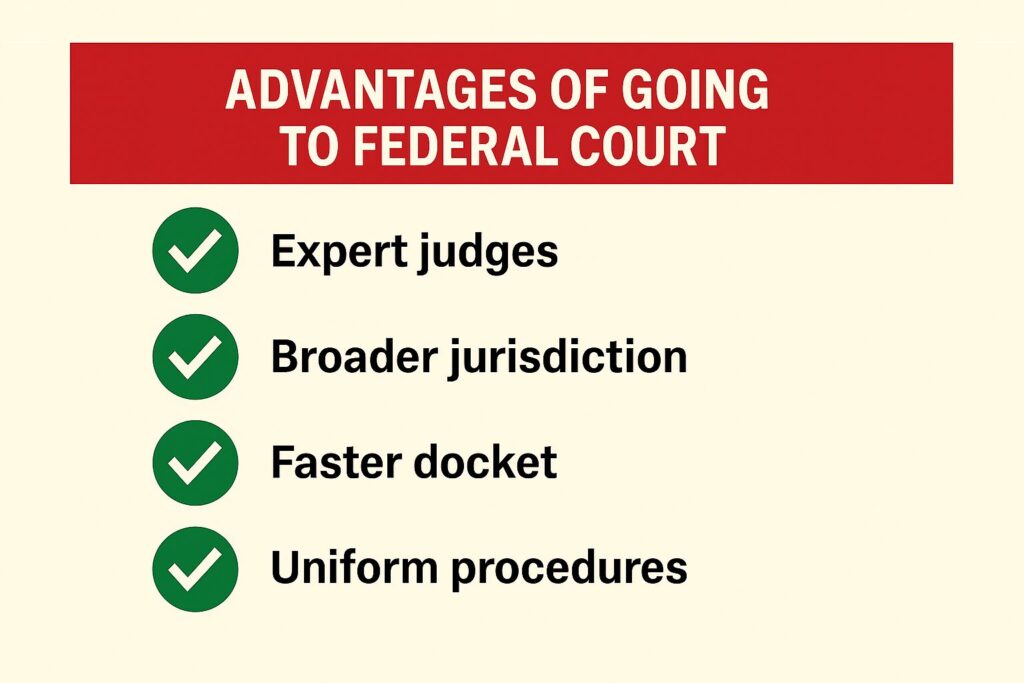
- 1. Federal Courts Are More Focused on Federal Law Federal courts are specifically tasked with interpreting and enforcing federal statutes, constitutional rights, and regulations. Since the right to ICF/IID care is grounded in federal law (such as the Medicaid Act and the Americans with Disabilities Act), federal judges are generally more experienced and attentive to these requirements than state courts, which often focus on state law.
- 2. Less Deference to State Agency Decisions While state courts (like Superior Court) often defer to the expertise and recommendations of state agencies, federal courts may be less inclined to simply accept agency findings at face value, especially if there is evidence that federal rights are being undermined. Federal judges are more likely to scrutinize whether state practices actually comply with federal law.
- 3. Broader Interpretation of Federal Rights Federal courts may interpret federal requirements such as the right to the “most integrated setting appropriate” more broadly and in line with the intent of Congress and federal regulations. This can result in a more balanced consideration of both community-based and institutional options, rather than defaulting to community placement.
- 4. Independence from State Agency Structures Federal judges are not part of the state administrative system. This independence can help ensure a more impartial review, especially when state administrative hearings and appeals are described as “closed loops” that favor agency decisions.
- 5. Enforcement Power Federal courts have the authority to issue orders that require state agencies to comply with federal law, and their decisions can set binding precedents that affect state practices beyond a single case.
But there are considerable drawbacks to filing in Federal Court:

🟩Get Support Before Choosing a Legal Path
Families should never feel they have to navigate this fight alone. The systems denying appropriate services or ICF/IID access are complex. The most effective strategies will come from working with organizations that understand both the law and the lived reality of high acuity needs.
We encourage every family to partner with an advocacy group before choosing a legal path. Locally, the Saving Wrentham and Hogan Alliance and the Coalition of Families and Advocates (COFAR) can help families understand their options and build a coordinated strategy.
Nationally, the National Council on Severe Autism (NCSA) and the Voice of Reason (VOR) offer additional expertise, policy insight, and support. Together, these organizations can help families choose the strongest, safest, and most effective approach rather than facing the system alone.
Please note: The above-referenced organizations offer support, not legal advice.