
Integration ≠ Elimination
Understanding the Supreme Court decision that protects care choice for people with disabilities
⚖️ What Is Olmstead v. L.C.?
In 1999, the U.S. Supreme Court ruled in Olmstead v. L.C. that under the Americans with Disabilities Act (ADA), individuals with disabilities have the right to receive services in the most integrated setting appropriate to their needs.
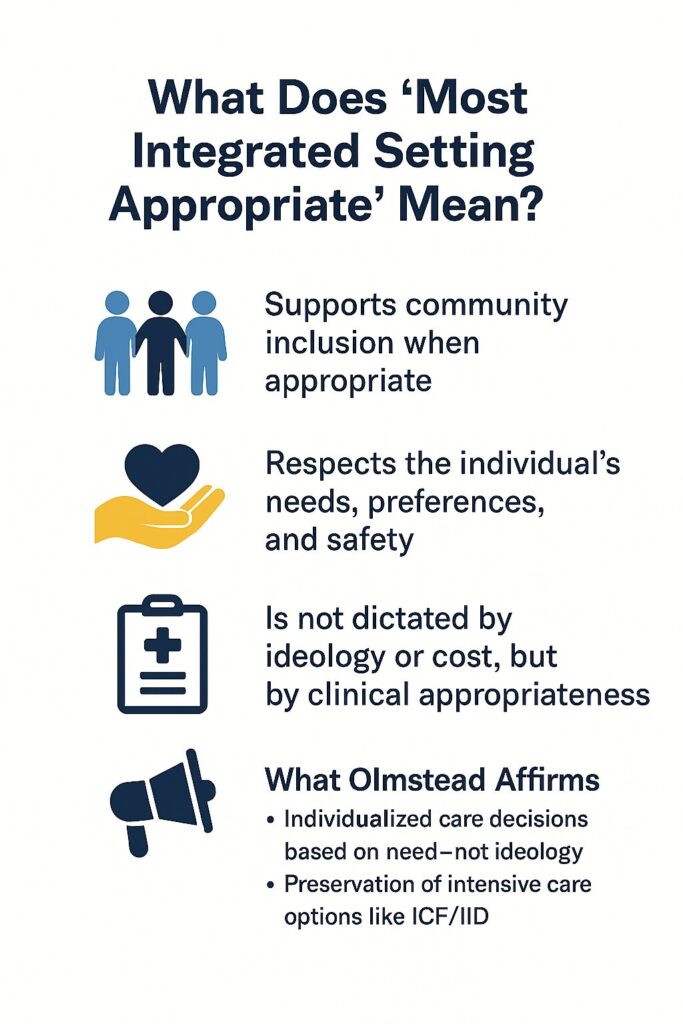
For some individuals, the most integrated setting is an Intermediate Care Facility for Individuals with Intellectual Disability (ICF/IID) facility—especially when they require 24/7 medical care, behavioral supports, or structured environments.
🚫 Misinterpretations of Olmstead
Myth: “Olmstead requires everyone to live in the community.”
Fact: Olmstead protects the right to appropriate integration—not forced relocation.
Myth: “ICF/IID care violates Olmstead.”
Fact: Denying access to ICF/IID when it is the appropriate setting may violate Olmstead.
Myth: “States can close facilities if they expand HCBS.”
Fact: States must ensure that closures do not leave individuals without access to the level of care they need.
🏛️ Massachusetts Context
Massachusetts Department of Developmental Services (DDS) has stated that ICF/IID placement is considered only after all community options are exhausted. This policy:
• Delays access to medically necessary care
• Forces individuals into inappropriate settings
• May violate federal law, including Olmstead and Medicaid regulations
Closing Wrentham and Hogan without viable alternatives risks violating Olmstead rights.
📢 What Olmstead Affirms
• 🧠 Individualized care decisions based on need—not ideology
• 🏥 Preservation of intensive care options like ICF/IID
• ⚖️ Legal protection against forced transitions or service denials
The Saving Wrentham and Hogan Alliance stands for:
• Upholding Olmstead as a tool for justice
• Ensuring equal access to all levels of care
• Defending the rights of individuals with severe disabilities
Olmstead Decision Text: Olmstead v. L. C. | 527 U.S. 581 (1999) | Justia U.S. Supreme Court Center