
ADA Rights: Access to Intermediate Care Facilities (ICF/IID) for Individuals with Intellectual Disabilities – Is This a Right?
🚫 Common Violations of ADA Rights
Denying ICF/IID admission unless all HCBS waiver options are tried
Closing facilities without ensuring alternative access to equivalent care
Pressuring families to accept community placements that are unsafe or inadequate
Failing to provide individualized assessments for care level decisions
✅ Why “Exhaustion” Policies May Violate the ADA
Denying ICF/IID admission unless all Home and Community-Based Services (HCBS) waiver options are tried can violate the ADA for several reasons:
1. It Restricts Individual Choice and Clinical Need:
- The ADA and the Supreme Court’s Olmstead decision require that placement decisions be based on the individual’s needs and preferences, not on blanket policies or administrative hurdles.
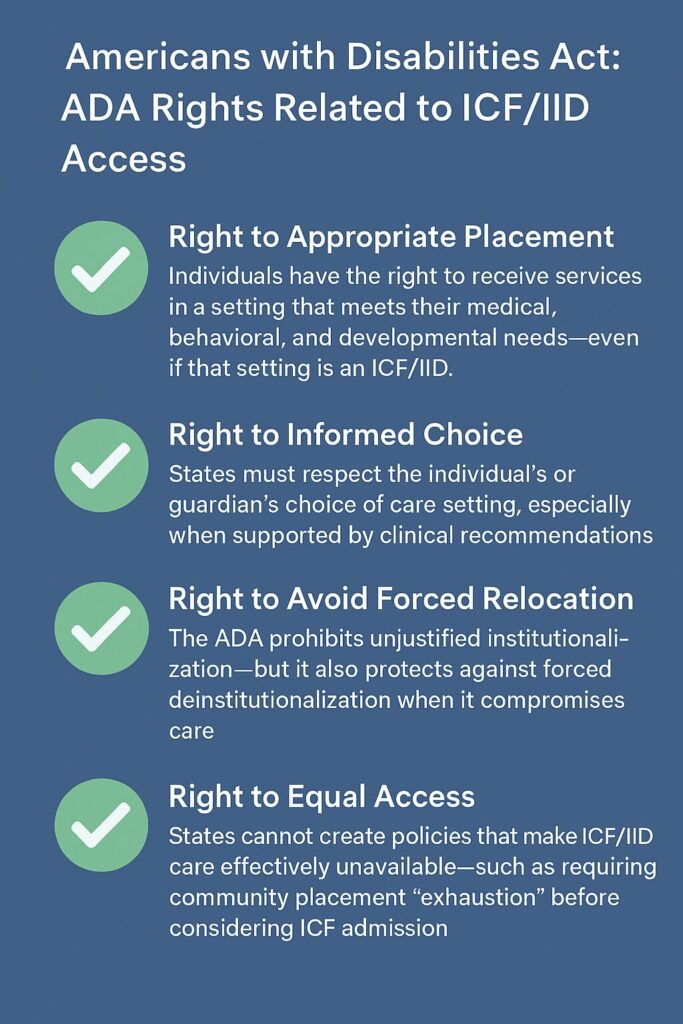
- Forcing individuals to “fail” in community placements before allowing ICF/IID admission disregards clinical recommendations and personal choice, which are protected under the ADA.
2. It Can Amount to Discrimination:
- Title II of the ADA prohibits public entities from discriminating based on disability. Policies that systematically deny access to ICF/IID care, or make it contingent on exhausting other options, can be seen as discriminatory because they deny a federally protected care option to those who need it.
3. It May Create “Effective Unavailability”:
- The ADA requires that states not make ICF/IID care “effectively unavailable.” If admission is only allowed after all Home and Community Based (HCBS) options are tried, it can delay or deny access to appropriate care, violating the right to equal access.
4. Legal Precedents and Regulations:
- The Olmstead v. L.C. (1999) decision clarified that integration must be appropriate to the individual, and that there is no federal requirement to impose community-based treatment on those who do not desire it.
- Federal regulations (28 CFR § 35.130(d); CMS ICF/IID Regulations) reinforce that services must be provided in the most integrated setting appropriate to the individual’s needs, which may include institutional care when warranted
✅Why Closing Facilities Without Alternatives May Violate the ADA
1. Denial of Equal Access:
- If a state closes ICF/IID facilities without providing equivalent alternatives, individuals who need that level of care may be left without any appropriate option. The ADA prohibits policies that make ICF/IID care “effectively unavailable,” which includes closing facilities without ensuring that those affected have access to equivalent care elsewhere.
3. Failure to Provide Individualized Assessments:
- The ADA requires that placement decisions be based on individualized assessments. If facilities are closed without considering each person’s needs and without ensuring alternative access to equivalent care, this requirement is not met. (28 C.F.R. § 35.130(h))
4. Legal Backing:
- Legal precedents such as Olmstead v. L.C. (1999) and federal regulations (28 CFR § 35.130(d); CMS ICF/IID Regulations) reinforce that services must be provided in the most integrated setting appropriate to the individual’s needs. Closing facilities without alternatives can violate these standards by denying necessary care.
✅Why Pressuring Families Is a Possible ADA Violation (See Informed Consent)
1. Compromises Individual Choice and Safety:
- The ADA requires that placement decisions be based on the individual’s needs and preferences, supported by clinical recommendations. Pressuring families to accept community placements that are unsafe or inadequate disregards these requirements and can put individuals at risk.
2. Prohibits Forced Deinstitutionalization:
- The ADA requires that placement decisions be based on the individual’s needs and preferences, supported by clinical recommendations. Pressuring families to accept community placements that are unsafe or inadequate disregards these requirements and can put individuals at risk.
3. May Constitute Discrimination:
- If families are pressured to accept placements that do not meet the individual’s needs, this can be seen as discrimination under the ADA, which requires equal access to appropriate care options.
4. Legal Backing:
- Legal precedents such as Olmstead v. L.C. (1999) and federal regulations (28 CFR § 35.130(d); CMS ICF/IID Regulations) reinforce that services must be provided in the most integrated setting appropriate to the individual’s needs. Unsafe or inadequate placements do not meet this standard.
✅Why Failing to Provide Individualized Assessments Is a Possible ADA Violation (See Support Evaluations)
1. Disregards Individual Needs and Preferences:
- The ADA and the Olmstead decision require that placement decisions be based on the individual’s needs and preferences, supported by clinical recommendations. Blanket policies or failure to assess each person individually can result in inappropriate placements that do not meet the person’s needs.
2. May Lead to Discrimination:
- If care level decisions are made without individualized assessments, some individuals may be denied access to appropriate care settings, which can be considered discrimination under the ADA
3. Violates Federal Regulations:
- Federal regulations (28 CFR § 35.130(d); CMS ICF/IID Regulations) reinforce that services must be provided in the most integrated setting appropriate to the individual’s needs. Without individualized assessments, it is impossible to determine the most appropriate setting for each person
🛡️ Legal Backing for ICF/IID Access
• Olmstead v. L.C. (1999): Integration must be appropriate to the individual
• 28 CFR § 35.130(d): Services must be provided in the most integrated setting appropriate
• CMS ICF/IID Regulations (42 CFR Part 483): Define standards for active treatment and rights of residents
📢 The Americans with Disabilities Act Resources
Legal Resources: ADA Title II Guidance – ADA.gov
Olmstead Decision Text: Justia Supreme Court Summary
ICF/IID Regulations: CMS ICF/IID Provider Guidance