
🧩What is an Intermediate Care Facility for Individuals with Intellectual Disabilities (ICF/IID)?
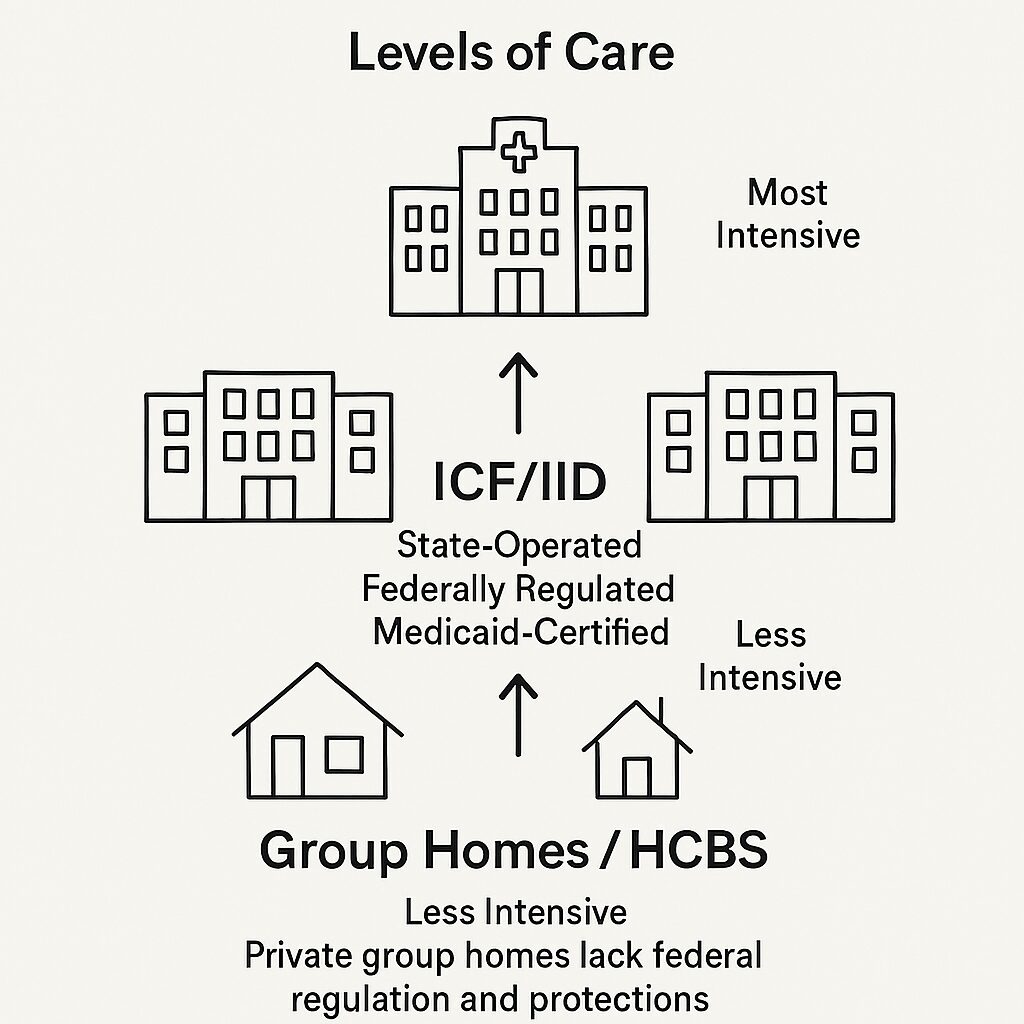
ICFs/IID provide an intermediate level of care for individuals with intellectual disabilities. They offer more support than group homes or other Home and Community-Based Services (HCBS), but not as medically intensive as hospitalization.
In Massachusetts, there are only two state-operated facilities, the Wrentham Developmental Center and Hogan Regional Center. These developmental centers deliver this federally regulated, Medicaid-certified care. If these facilities were to close, Massachusetts would lose access to this specific level of licensed care.
While Massachusetts does have private group homes that offer ICF-like services, these settings are not federally regulated and do not provide the same standards or protections as the licensed ICF/IID facilities. In contrast, some other states have privately operated ICFs/IID and group homes that are subject to federal oversight, but Massachusetts does not currently have any privately run ICF/IID facilities of this type.
🛡️Who Benefits from ICF/IID Care and Treatment?
These facilities are specifically tailored for individuals with intellectual and developmental disabilities (IDD) who require a structured, intensive level of support that goes beyond what typical community-based services offer.

History
In the 1970s, legal reforms stopped warehousing people with IDD in state facilities. Consent decrees and settlements established standards for active treatment, while federal licensing of ICF/IID facilities ensured further improvements. States could only bypass these requirements by shifting individuals to another care model like Home and Community-Based Services (HCBS).
Today, the remaining ICF/IID facilities, particularly those in Massachusetts, offer the active treatment that the great advocates of the 1960s and 1970s fought so hard to put into place.
🏥Services and Departments at The Wrentham Developmental Center (WDC) and other ICF/IID Facilities
The Wrentham Developmental Center (WDC) in Massachusetts offers various services and departments[i], similar to those at the Hogan Regional Center in Danvers and other ICF/IID facilities across the US. Services at WDC include but are not limited to:
Quality Enhancement: Qualified professionals manage an average caseload of 30 residents, acting as clinical case managers and primary advocates. They are responsible for the development and implementation of the Individual Support Plan (ISP).
Medical Services: The department is overseen by a qualified physician and nurse practitioner. Basic medical services are provided on campus, with healthcare professionals being part of the interdisciplinary team. Medical services include annual medical evaluations and routine laboratory screenings. The medical program includes periodic follow-up for all identified medical conditions. The medical department develops long-term treatment plans for individuals with chronic illnesses and communicates with outside specialists when necessary. Wrentham has its own medical hospital that provides non-urgent care, postoperative follow-up and rehabilitation, and overnight observation. Medical specialty service clinics include cardiology, gastroenterology, neurology, ophthalmology, podiatry, and pulmonary. There is also a part-time psychiatrist on staff.
Nursing Services: A qualified nurse oversees the department. Nursing services are provided to all residents through a rehabilitative model, aiming for optimal independence. Only licensed personnel administer medications and treatments. Nurses are available 24/7 to address health problems, coordinate emergencies, and communicate with medical professionals. Each resident is assigned a qualified nurse to monitor his/her medical care and medical status.
Dental: The Tufts Dental Facility (TDF) at the Wrentham Developmental Center offers comprehensive dental care for adults and children with developmental disabilities. Established in 1976 following the Ricci V. Okin lawsuit, TDF was created to meet the demand for specialized dental care. TDF remains dedicated to serving individuals with developmental disabilities, continuing its vital services, including service to thousands of individuals living at home or in group homes.
Community and Social Services: This department is led by a masters level social worker and includes a team of other masters level social workers. Each resident has a social worker to help maintain family connections and provide support to families and representatives. Social workers also supervise Service Specialists who offer one-on-one activities weekly.
Psychological Services: A PhD-level psychologist supervises psychology technicians who create positive behavior support (PBS) plans to develop skills that replace inappropriate behavior. The department has a track record of helping individuals with behavioral challenges, psychiatric disorders, and complex medical needs.
Occupational Therapy: Accredited occupational therapists work to improve independence, health, and safety in daily living activities. WDC provides direct occupational therapy from accredited occupational therapists.
Physical Therapy: Physical therapy services aim to maximize functional mobility and minimize impairments to promote the highest level of health for each individual. WDC provides direct physical therapy delivered by a qualified and accredited physical therapist.
Adapted Physical Education: Physical Education Specialists provide individualized exercise, fitness, and movement programs specifically designed for each individual. They collaborate closely with dietary staff to support individuals with medical conditions that put them at higher risk for life-threatening diseases.
Assistive Technology: WDC has an Assistive Technology Resource Center that works to enhance personal independence through products, systems, and technologies. These services are sometimes offered to residents who live in the larger community as well.
Developmental Services Department: The adult education program provides various learning activities, including sensory stimulation and adult education/academic programs. Daily classes cover academics and pre-academics, skill maintenance and acquisition, and daily living activities such as basic hygiene, domestic skills, and meal preparation.
Vocational Services: The vocational services department provides both work and unpaid volunteer opportunities to individuals at WDC. The program offers skills training, work assessments, and vocational placement with supports in conjunction with appropriate workplace skills training.
Recreational Services: According to clinical assessments and the needs and preferences of residents, the recreational department offers leisure skills training and opportunities for community integration. Activities include trips to movies, farms, museums, restaurants, concerts, theatre, and sporting events. These services feature various activities around holidays and ethnic traditions. Recreational staff arrange dinner dances, cookouts, aquatics, hayrides, kayaking, karaoke, and opportunities to participate in competitive sports in Special Olympics as well as non-competitive sports. The therapeutic pool is accessible to all residents no matter what level of physical disability and is fully wheelchair accessible.
Speech and Language Services: WDC offers direct speech therapy with a qualified, accredited therapist. The focus is on enhancing individuals’ receptive, expressive, and social language skills, managing swallowing difficulties, and using augmentative communication devices
Comparison of | ||
Feature/Aspect | ICF/IID | Group |
Regulation | Federally regulated, Medicaid-certified | Private group homes: not federally regulated; HCBS: |
Location(MA) | Only 2 state-operated facilities (Wrentham, Hogan) | Many private group |
Care Intensity | Intermediate | Less intensive |
Medical Services | On-site physician, nurse practitioner, hospital, | Varies, often limited, may lack qualified staff |
Nursing Services | 24/7 licensed nurses, medication administration | Varies, may lack licensed personnel |
Dental Services | On-site specialized dental facility ( Tufts Dental) | Varies, often limited access |
Psychological Services | PhD-level psychologist, behavior support plan | Varies |
Therapies (OT/PT/Speech) | Accredited therapists on-site; direct therapies | Varies, often does not include direct therapies |
Community Integration | Structured recreational, vocational, and educational | Varies |
Individual Support Plans | Developed and managed by qualified professionals | Varies |
Federal Protections | YES | Unlike ICF/IID, HCBS protections are governed by federal rules rather than enforceable Conditions of Participation. HCBS rules provide important rights-based protections, but enforcement is decentralized and varies by state. Federal HCBS rules set standards but lack the direct federal survey and enforcement mechanisms found in ICF/IID. |
Take Action to Protect Specialized Care
Wrentham Developmental Center and Hogan Regional Center are irreplaceable lifelines for individuals with intellectual and developmental disabilities in Massachusetts. Their federally regulated, Medicaid-certified care ensures safety, dignity, and opportunity for those who need it most.
Help us preserve these vital facilities:
- Learn more about the difference ICF/IID care makes.
- Share your story or testimonial to raise awareness.
- Contact your legislators and urge them to support continued funding and protection for Wrentham and Hogan.
- Join our alliance—sign up for updates, volunteer, or advocate with us.
- Learn why families rarely hear about ICF/IID care in Massachusetts
Together, we can ensure that every individual with intellectual and developmental disabilities receives the care and respect they deserve.
[i] Commonwealth of Massachusetts Department of Developmental Services: Wrentham Developmental Center, February 2022