
Understand Why
For many families navigating the disability service system, the landscape can feel confusing, fragmented, and full of hidden assumptions. Families rarely hear about ICF/IID care. One of the most common questions we hear is:
“Why didn’t anyone tell me about all the options, including ICF/IID care?”
What is state-operated ICF/IID care in Massachusetts?
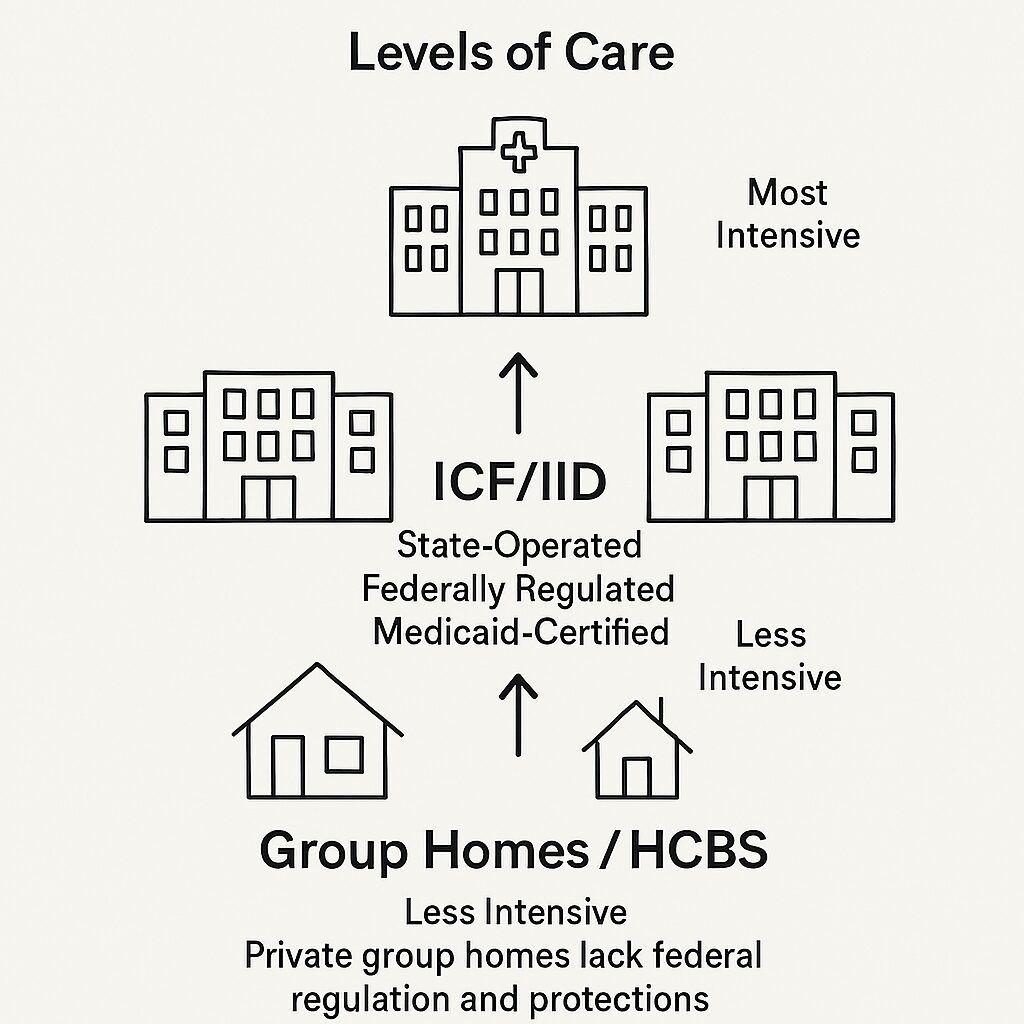
It’s a fair question. Massachusetts, like many states, has spent decades building a system where Home and Community‑Based Services (HCBS) are the dominant model. HCBS plays an important role for many people, but it’s not the only federally recognized option, and it’s not the right fit for everyone, especially those with high medical or behavioral needs.
This post explains how the system evolved and why some options are less visible than others.
1. HCBS became the primary model because it grew rapidly over time
Over the past several decades, states across the country expanded HCBS programs to support people in small homes, shared living, and individualized community settings. This growth happened gradually, through hundreds of private providers and thousands of placements.
As HCBS expanded, it naturally became the “default” model that most families encounter.
2. Funding structures shape what families hear about
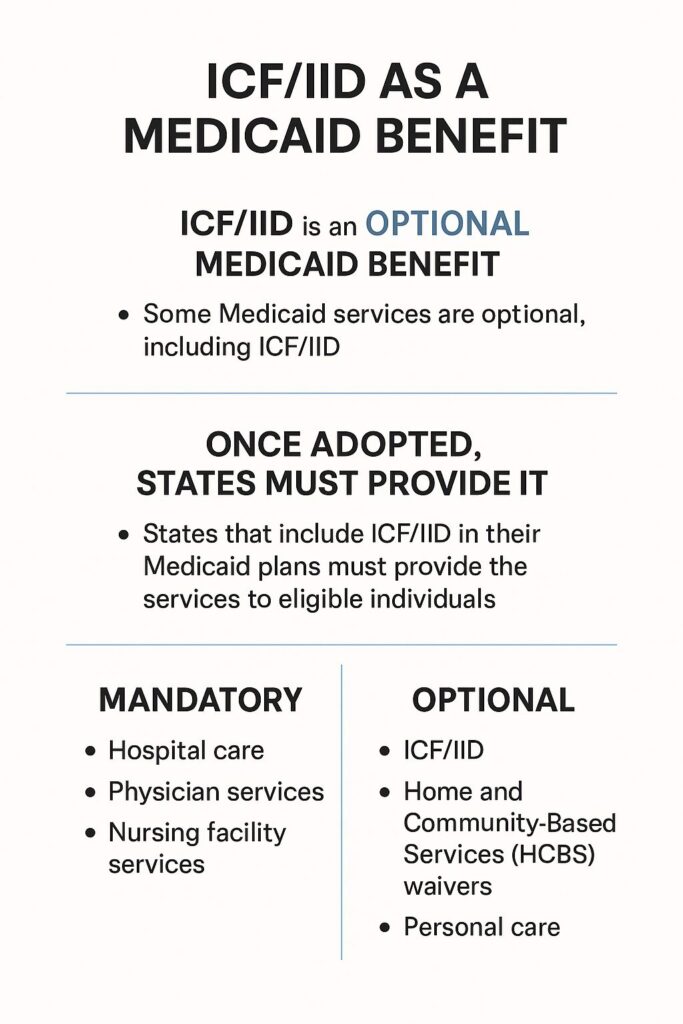
HCBS programs are funded through Medicaid waivers, which allow states to design flexible services and partner with many community agencies. Because these programs are widespread and decentralized, they tend to be the most visible part of the system.
By contrast, ICF/IID care, a federally defined, highly regulated option for people with intensive needs, is less common and less widely discussed, even though it remains part of the Medicaid program.
3. Most families only learn about the options that staff are trained to present
Service Coordinators and case managers typically receive extensive training on HCBS programs, since those are the services they work with every day. As a result, families often hear a great deal about HCBS and very little about the full continuum of care.
This is a reflection of how the system is structured and what information is emphasized.
4. ICF/IID care is often misunderstood
Many people assume that ICF/IID settings no longer exist or that they are outdated models of care. In reality, ICF/IID facilities continue to operate in Massachusetts and across the country, providing 24‑hour clinical, behavioral, and nursing support for individuals with the most complex needs.
Because the model is less familiar, families may not realize it is still could be an option.
While ICF/IID settings are classified as institutions, today’s facilities bear no resemblance to the old institutions of the past -thanks to the tireless work of advocates in the 1970s and 1980s who pushed for dignity, safety, and individualized care.
5. States nationwide have shifted toward community‑based services
Massachusetts is part of a national trend. Over the past 30 years, states have invested heavily in community‑based supports, often with the goal of helping people live in smaller, more individualized settings.
This shift has many benefits, but it also means that some families never hear about the full range of federally supported options, including ICF/IID care.
6. Families deserve clear, complete information about all available pathways
Every individual and family has unique needs, preferences, and goals. No single model works for everyone. Some people thrive in HCBS settings; others require the clinical intensity and stability that ICF/IID care provides.
What matters most is informed choice, and that begins with transparent, accessible information.
7. Part of our mission is to help families understand the full continuum of care
We believe that families should be empowered with accurate, balanced information about every option available under federal law. That includes HCBS, shared living, group homes, individualized supports, and ICF/IID care.
While ICF/IID care remains part of the federal Medicaid program, Massachusetts rarely accepts new admissions into its state‑operated ICF/IID facilities. This lack of access is one reason many families never hear about the model today. The Saving Wrentham and Hogan Alliance is actively working to change this by advocating for the reopening of admissions so that individuals with the highest needs can once again access the full continuum of care.
When families understand the full landscape, they can make decisions that truly reflect their loved one’s needs.
Join our Facebook group:
Join the Saving Wrentham and Hogan Alliance to advocate for the full continuum of care in Massachusetts.
One thought on “Families Rarely Hear About ICF/IID Care in Massachusetts”
An impressive share! I have just forwarded this onto a coworker who had been doing a little research on this.
And he in fact bought me lunch simply because I stumbled upon it for
him… lol. So let me reword this…. Thank YOU for the meal!!
But yeah, thanks for spending time to discuss this issue here on your website.