
As the Massachusetts House prepares to debate the FY2027 budget, families across the state are watching several important amendments that directly affect individuals with the highest levels of need. Three amendments — #695, #699, and #703 — address a fundamental issue in our state’s disability services system: the absence of a clear, lawful pathway to Intermediate Care Facility (ICF/IID) services for individuals who qualify for that level of care.

Some have described these amendments as creating new rights. In reality, they do something far more basic and long overdue: they ask Massachusetts to comply with federal Medicaid law that already exists.
Federal law already guarantees a choice between ICF/IID and Home and Community Based Services (HCBS) services
Under federal Medicaid law, individuals who are determined eligible for ICF/IID level of care must be offered:
- information about all feasible alternatives, and
- a meaningful choice between institutional services and home‑ and community‑based services (HCBS)
This requirement is not new. It has been part of federal Medicaid regulations for decades.
Court decisions have affirmed that states must:
- provide ICF/IID services with reasonable promptness to eligible individuals, and
- ensure that people understand their options and can choose the setting that meets their needs.
The challenge in Massachusetts is not the law itself. It is the absence of a functioning, transparent process for individuals who need ICF/IID services and cannot be safely or appropriately served in the current HCBS system.
Budget Amendments #695, #699, and #703 do not expand federal rights. They simply reinforce the state’s obligation to follow them.
Restoring choice strengthens the entire system, including community‑based services
Some worry that acknowledging the ICF/IID option will weaken community programs. But experience in other states shows the opposite.
When families have no real choice, systems stagnate. When there is choice and competition, quality improves across all settings.
A complete continuum of care — one that includes both HCBS and ICF/IID — creates:
- better matching of services to individual needs
- pressure to improve quality in all settings
- greater transparency about what each model can and cannot provide
- a more honest conversation about staffing, safety, and clinical capacity
Community‑based services do not get weaker when ICF/IID services exist. They get stronger, because the system is no longer forced to stretch one model to cover every level of need.
Why these amendments matter now
Families across Massachusetts report the same pattern:
- individuals with high medical or behavioral needs are placed in settings that cannot meet those needs
- providers are asked to deliver care far beyond their staffing or clinical capacity
- families are told that ICF/IID services “no longer exist,” even though they remain part of federal Medicaid law
- there is no clear process for requesting or accessing ICF/IID placement
- providers are increasingly refusing to accept individuals with high‑acuity medical or behavioral needs altogether
Budget Amendments #695, #699, and #703 are modest but meaningful steps toward restoring the federally required continuum of care.
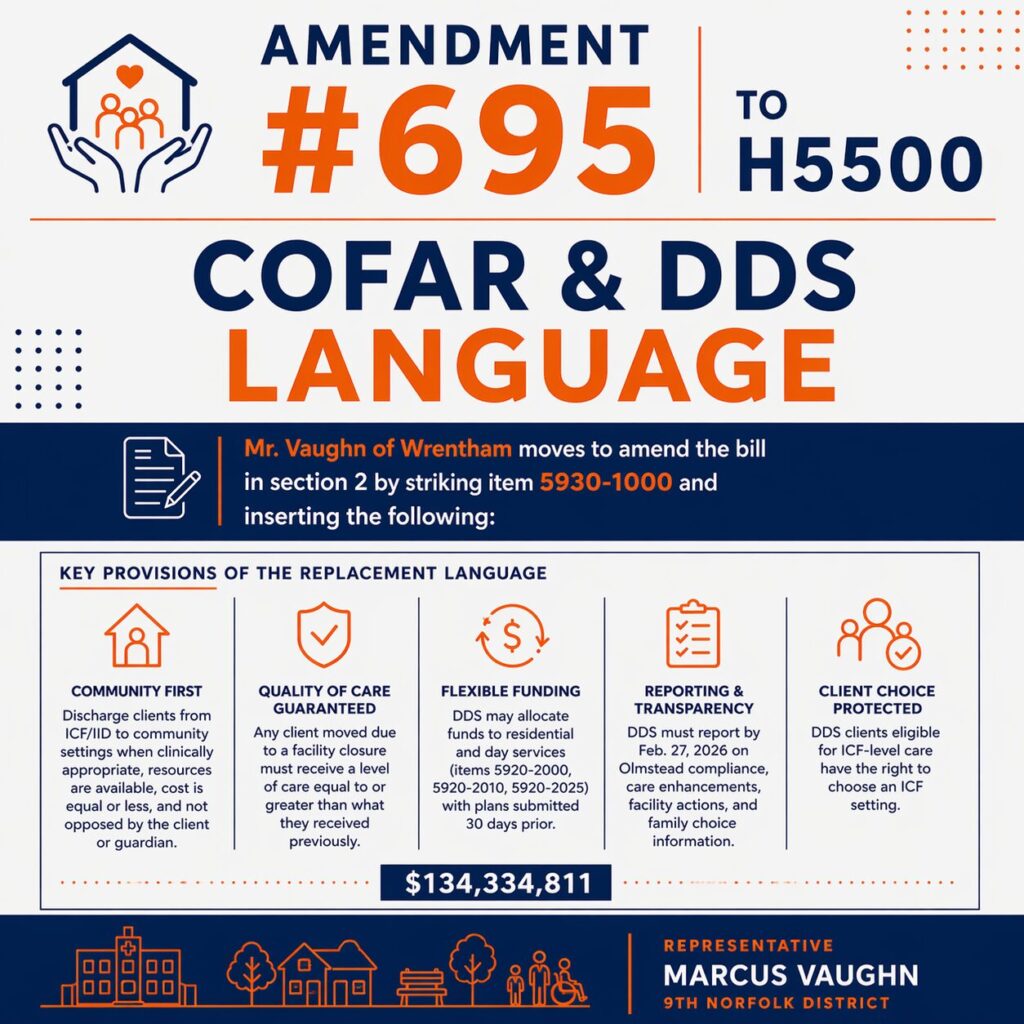


What families can do
The House debate begins next week. COFAR has asked families to contact their state representatives and urge them to co‑sign these amendments now.
If you believe that Massachusetts should comply with federal law — and that individuals with the highest levels of need deserve real options — your voice can make a difference.
You can find your state representative here: https://malegislature.gov/Search/FindMyLegislator
A short message is enough. What matters is that legislators hear directly from families who understand the stakes.
Moving forward
SWHA will continue to advocate for a system that is lawful, transparent, and responsive to the full range of needs in our community. Restoring the federally required choice between HCBS and ICF/IID services is not a step backward. It is a step toward a more complete, more accountable, and more humane continuum of care.
If you would like talking points or help contacting your legislator, please reach out on our contact form.
One thought on “Why Budget Amendments #695, #699, and #703 Matter: Reinforcing Disability Rights that Exist Under Federal Law”
Save Wrentham!!!! We gave an obligation to those who need these incredible services and living needs.