
MA IDD Lawsuit Series: Part 3
Massachusetts has long claimed to be a national leader in community living for individuals with intellectual and developmental disabilities (IDD). Although the state often tells families that adults with IDD are ‘not entitled’ to services, federal law says otherwise — and the Boulet lawsuit made that unmistakably clear.
For thousands of people with IDD, “community living” meant being placed on a waitlist with no residential supports. Boulet revealed a truth Massachusetts still avoids: eligibility means nothing when the state refuses to provide the services federal law requires.
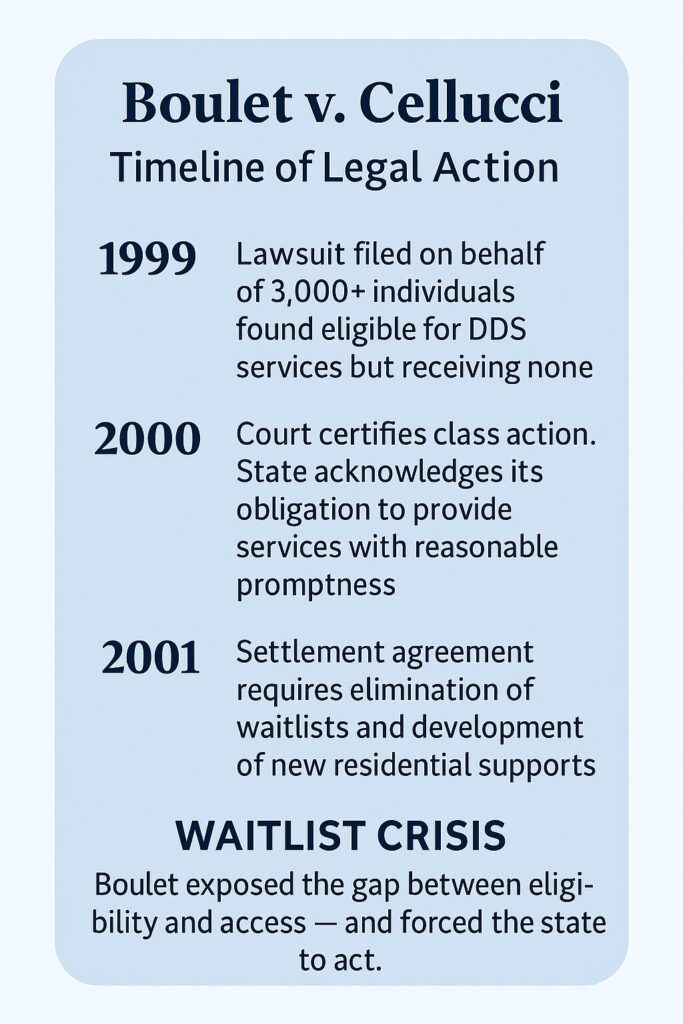
Boulet v. Cellucci was filed in 1999 on behalf of more than 3,000 individuals who had been found eligible for Department of Developmental Services (DDS) but were receiving no residential habilitative supports. To understand the magnitude of this failure, it helps to look at another case decided the very same year. Seen side by side, the contrast is stark. While Olmstead—a Georgia case—clarified a federal requirement to provide community services when appropriate, Boulet exposed Massachusetts’ failure to provide even the most basic services to people already deemed eligible.
Boulet and Olmstead — Two Sides of the Same Federal Mandate
Olmstead clarified that institutionalization is discriminatory when a person wants to live in the community and the state has the capacity to support them there. It was a case about unnecessary institutionalization.
Although Olmstead and Boulet were decided in the same year, Olmstead interpreted ADA and Section 504 obligations that had existed for years, so Boulet plaintiffs could rely on that ruling to show Massachusetts was violating the ADA’s community‑based services requirement.
Boulet v. Cellucci (1999) revealed the mirror image of the Olmstead problem. Instead of keeping people in institutions who wanted to live in the community, Massachusetts had eliminated institutional options and failed to build community services. Thousands of adults with IDD were not institutionalized — not because community services were available, but because the state had already made intermediate care facilities for individuals with intellectual disabilities (ICF/IID) care inaccessible. Rather than providing services in the community, the Commonwealth simply provided nothing.
Both cases rest on the same federal principle:
States must provide the services individuals are entitled to under Medicaid.
- Olmstead enforced the right to community services.
- Boulet enforced the right to residential habilitation.
Together, they show that a state violates federal law whether it:
- forces people into institutions, or
- eliminates institutional options without building the required community system
Massachusetts did the latter — and Boulet forced the state to comply with federal entitlements it had long ignored.
Governor Paul Cellucci and Disability Policy in Massachusetts
Paul Cellucci served as Governor of Massachusetts during a period marked by major disability‑rights litigation, including Boulet v. Cellucci and Rolland v. Cellucci. His administration became a focal point for disability advocates who argued that state policies consistently fell short of meeting the needs of people with disabilities.
One of the most consequential policy shifts associated with Cellucci was the state’s move away from the “maximum feasible benefit” standard in special education. Under his administration, Massachusetts aligned itself with the federal “free and appropriate public education” (FAPE) standard. Advocates widely criticized this change as a lowering of expectations for students with disabilities — one that reduced legal protections without producing meaningful cost savings.
During the same period, the Commonwealth faced multiple class‑action lawsuits alleging systemic failures in providing appropriate services and community supports. For many families, these cases symbolized a broader pattern: the state’s resistance to fulfilling its obligations until compelled by federal court oversight. It was within this policy landscape that the Boulet lawsuit emerged.
Years after leaving office, Cellucci was diagnosed with ALS. Many disability advocates noted the painful irony that a governor whose policies had narrowed access to services for disabled individuals ultimately became disabled himself. Others saw his diagnosis as a reminder that disability is universal — it enters lives without regard to politics, and public policy decisions eventually touch everyone.
Case Overview
- Plaintiffs: Five adults with intellectual disabilities, including Edmund Boulet, acting through their parents/guardians.
- Defendants: Massachusetts state officials, including then-Governor Argeo Paul Cellucci and officials from the Department of Mental Retardation (DMR, the predecessor to today’s Department of Developmental Services).
- Legal Basis: The plaintiffs cited the Medicaid Act, specifically 42 U.S.C. § 1396a(a)(8), which mandates that Medicaid assistance be provided “with reasonable promptness” to all eligible individuals.
To understand why the Boulet plaintiffs were entitled to services, it’s important to look at how federal Medicaid law defines ICF/IID services and the rights that flow from that definition.
Individuals Were Entitled to Services According to Federal Law, but the State Did Not Provide Them
Families were entitled to residential habilitation under federal law because intermediate care facilities for individuals with intellectual disability (ICF/IID) services are a federally defined Medicaid benefit under 42 U.S.C. § 1396d(d). And because Massachusetts includes ICF/IID in its State Medicaid Plan, individuals who meet the level‑of‑care criteria are entitled either to the ICF/IID service itself or to its home‑ and community‑based (HCBS) equivalent, provided with “reasonable promptness” under 42 U.S.C. § 1396a(a)(8).
Families were entitled to Home and Community-Based Services (HCBS) waiver services because federal law allows HCBS only as an alternative to ICF/IID care. Once a person meets the ICF/IID level of care, the state must provide either institutional habilitation or an HCBS waiver slot that substitutes for it. The HCBS waiver does not replace the ICF/IID entitlement; it exists because of it, and individuals who qualify for ICF/IID care have a federal right to receive either the institutional service or its community‑based equivalent.
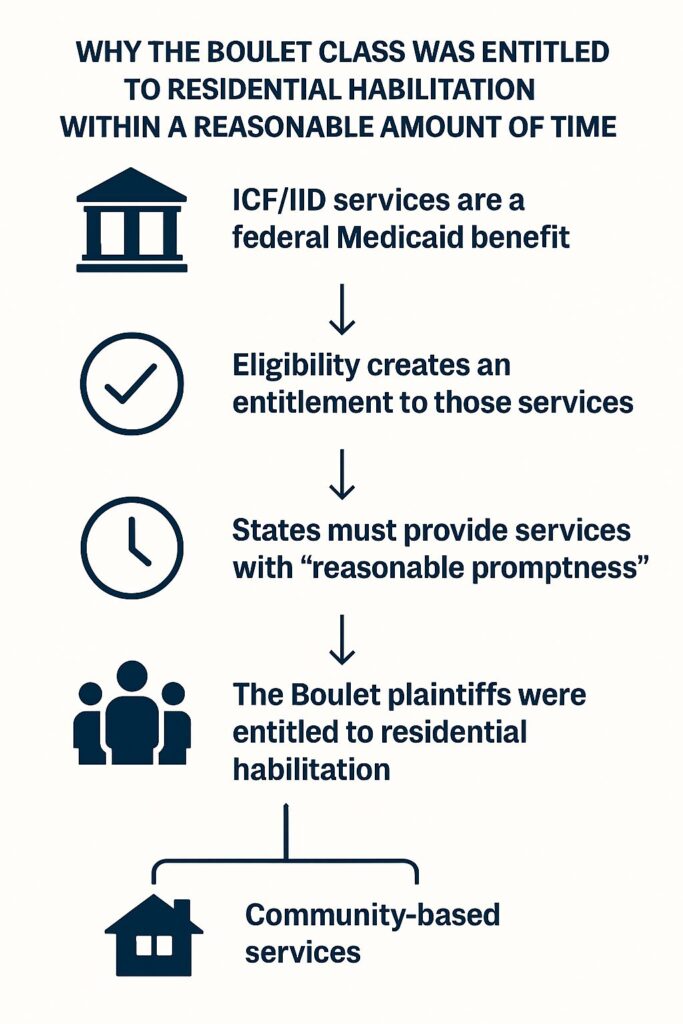
The claim that “there are no entitlements” is simply false.
Once a state includes ICF/IID services in its Medicaid plan, federal law makes those services an entitlement for every eligible individual. HCBS waivers exist only as an alternative to ICF/IID care, not a replacement for it. Individuals who meet ICF/IID level of care are entitled to either institutional habilitation or its community-based equivalent — and states must provide those services with reasonable promptness.
So why do states continue to deny these federally mandated services? Not because the entitlements don’t exist, but because no federal lawsuit has compelled compliance. Without litigation or federal oversight, states routinely violate Medicaid requirements while telling families they have no rights. Disability organizations and uninformed attorneys often echo these claims, reinforcing the false narrative that services are discretionary.
Boulet succeeded because the plaintiffs were enforcing real federal entitlements — not asking for favors, not seeking policy change, but invoking the legal rights that Medicaid guarantees to every eligible individual. The case would not have succeeded if those entitlements didn’t exist
Why Families Are Told There Are “No Entitlements”
Section 1: Why Organizations Repeat the State’s Narrative
Many disability organizations and even well‑meaning attorneys routinely tell families that adults with IDD are “not entitled” to residential or community‑based services. This message is widespread, but it is not grounded in federal law.
Disability organizations often rely on state funding, state partnerships, and state‑controlled advisory roles. Challenging the state’s failure to provide federally mandated services can jeopardize those relationships. As a result, these organizations tend to frame services as discretionary, emphasize “collaboration,” and avoid acknowledging the federal entitlements that would require the state to act.
Section 2: Why Attorneys Get It Wrong
Many attorneys who work in guardianship, special needs planning, or benefits navigation are not trained in Medicaid litigation. They repeat what DDS staff tell families — that services are limited, optional, or subject to state priorities — without examining the federal statutes that actually govern eligibility and entitlement.
This ecosystem of misinformation reinforces the false belief that adults with IDD have no enforceable rights. Boulet shows the opposite: the plaintiffs prevailed because federal law had already created binding entitlements to the services they were denied. Without those pre‑existing rights, the lawsuit would have had no legal foundation
What the Lawsuit Claimed
In their complaint, the Boulet plaintiffs alleged that Massachusetts was violating multiple federal laws by failing to provide required services. Specifically, they argued that the state was: violating, the Medicaid Act (42 U.S.C. § 1396 et seq.), the Americans with Disabilities Act (ADA), Section 504 of the Rehabilitation Act (Section 504 (29 U.S.C. § 794)), and later in the lawsuit—the Supreme Court’s Olmstead decision.
By failing to provide services in a timely, integrated, and appropriate manner, the state was:
- denying access to federally funded programs
- forcing individuals into isolation
- placing families under extreme strain
- violating the rights of people with IDD to live in the community with support
What the Case Revealed
Boulet exposed a system in which:
- DDS maintained long waitlists for services
- Individuals with high needs received no supports
- Families were told to “wait until there’s funding”
- Community living was promised but not delivered
- The state shifted costs to families, schools, and emergency systems
It showed that Massachusetts had embraced the language of community living, but not the infrastructure.
Sidebar: A Community Divided — The Hidden Story Behind Boulet
These violations were not abstract — they produced real fractures within the disability community, which shaped both the litigation and its aftermath.
One rarely discussed aspect of Boulet is the deep divide it exposed within the disability community itself. Families who had secured ICF/IID placements decades earlier were receiving stable, 24‑hour care. Families who kept their children at home — believing community services would eventually be built — were left on endless waitlists.
The resentment was real. As Mary Ann Boulet told the Boston Globe in 1993, “They put kids in institutions long ago. I kept mine home. But they are getting the lion’s share of the money.”
John Sullivan, whose daughter lived in an ICF/IID, responded: “Because we had the foresight to place a severely retarded person years ago, when there was nothing in the community, they are angry and jealous about what we did.”
Advocacy groups amplified this tension by circulating cost comparisons claiming the state spent $100,000 per year per individual on institutional residents but only $17,455 on community services — a figure that even in 1993 could not have reflected the true cost of 24/7 care.
This fracture — created by scarcity and maintained by political messaging — shaped the Boulet litigation and continues to influence disability policy today.
The Settlement and Its Impact
In 2001, the state entered into a settlement agreement requiring:
- the elimination of waitlists for certain services
- the development of new residential and day supports
- the creation of individualized service plans
- improved oversight and accountability
The settlement did not change the underlying federal rights — it simply forced Massachusetts to comply with them. Under that court‑ordered pressure, DDS finally expanded services that had been withheld for years.
And like Ricci and Rolland before it, Boulet demonstrated that Massachusetts does not act until litigation forces its hand.
Why Boulet Still Matters Today
Boulet focused on people who were eligible for services but did not receive them.
Today, we see a similar pattern:
- Individuals approved for Day Habilitation are denied access
- High‑acuity adults are turned away from group homes
- Families are told “there’s no capacity”
- DDS claims to support community living, while failing to fund it
Boulet reminds us that eligibility means nothing without access.
And access means nothing without quality.
How Massachusetts Uses “Self‑Direction” and “Natural Supports” to Mask Service Denials
The issue is not self‑direction itself, but the state’s use of it as a substitute for services it is legally required to provide. Self‑directed services can be a valuable and empowering option for families who choose them. The problem arises when self‑direction becomes the only option because the state has already denied access to ICF/IID or HCBS residential services.
Massachusetts increasingly funnels individuals who have been rejected by providers into self‑directed arrangements, regardless of whether this model can meet their needs. On paper, this looks like “choice.” In practice, it can mean no services at all (e.g., an “empty waiver”).
When the state invokes “natural supports,” responsibility shifts to aging parents, siblings, and unpaid caregivers. This framing allows the Commonwealth to avoid acknowledging provider refusals, lack of capacity, long delays, and outright denials.
By steering people into self‑direction and relying on “natural supports,” Massachusetts obscures the same systemic failures that Boulet exposed more than two decades ago. The state can claim individuals are “served,” even when families are carrying the full burden alone.
This is the modern version of the Boulet problem: eligibility without access, and “community living” without actual services.
The Larger Pattern
Boulet was not an anomaly; it was part of a recurring cycle in Massachusetts disability policy. This cycle continues today, as families confront the same denials Boulet exposed more than two decades ago.
With Boulet, the pattern repeats:
- The state ignores systemic failure
- Families suffer in silence
- A federal lawsuit exposes the harm
- The court mandates reform
- The state complies only under pressure
Massachusetts did not expand community services because it believed in them.
It expanded them because it was sued. Boulet showed that rights exist whether or not the state acknowledges them — and that families must sometimes enforce those rights to make them real.
The Saving Wrentham and Hogan Alliance believes that every individual with IDD deserves timely, appropriate, and high‑quality services — whether in the community or in specialized settings. Boulet showed that community living without services is not inclusion. It’s abandonment.
What Comes Next
Next in the series: Hutchinson v. Patrick, a case that challenged the adequacy of community services and the state’s failure to comply with Olmstead.
Although Hutchinson involved adults with acquired brain injuries rather than IDD, the lawsuit exposed systemic failures that affect both.
Previous Installments
To read or listen to the Introduction to our MA IDD Lawsuit series, Introduction: “Why Massachusetts Keeps Getting Sued Over Disability Services,” click here.
To read or listen to Part 1 of our series, “What the Rolland Lawsuit Reveals About Massachusetts’ Real Commitment to Community Living,” click here.
To read or listen to Part 2 of our series, “Ricci v. Okin: The Lawsuit That Forced Massachusetts to Fix Its Institutions,” click here.
Join the Saving Wrentham and Hogan Alliance
As we continue our MA IDD Lawsuit Series, we invite families, advocates, and allies to help us document the present crisis and protect the future. Contact Us.