
Why This History Matters Today
The story you’re about to read is not just about the past. It is about the decisions that shape the lives of people with the highest needs right now — people who cannot speak for themselves, who rely on us to tell the truth about what happened, and who live with the consequences of policies built on a distorted history. Understanding how the state rewrote its institutional past is essential to understanding why our system looks the way it does today, and why so many families are still fighting for safe, stable, and clinically appropriate care.
To understand how we arrived at the system we have today, we have to look back at the history that shaped it.
Before Massachusetts ever faced the failures exposed in Rolland, the state had already been under federal court scrutiny for decades.
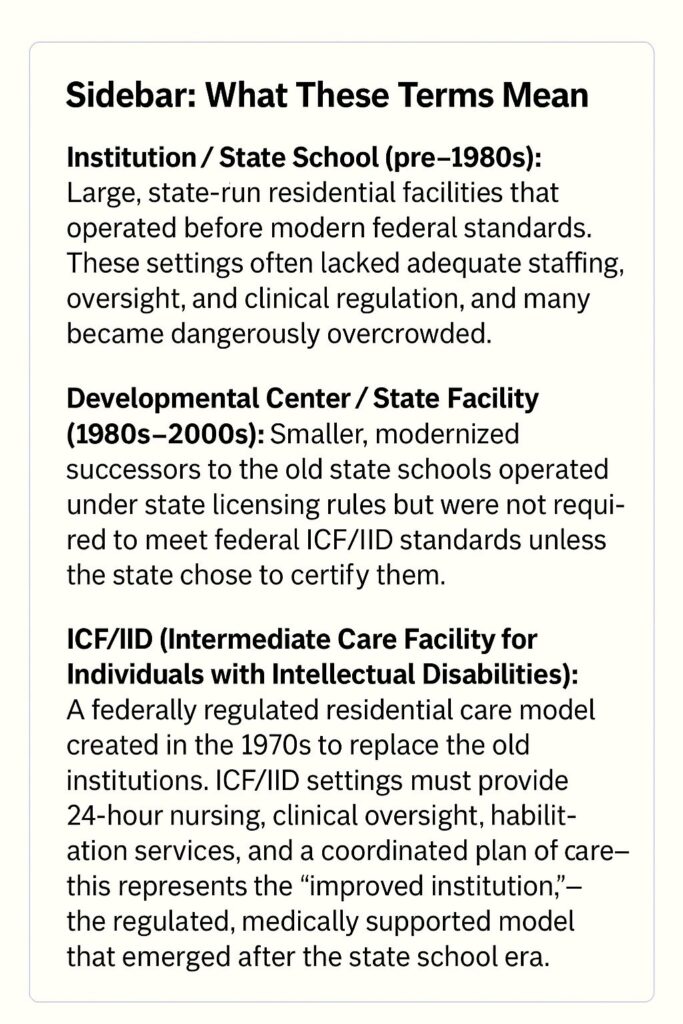
Ricci v. Okin, filed in 1972, emerged in a period when children and adults with intellectual disabilities were routinely sent to state institutions because there were no community services and no legal right to a public education. At that time, none of the federal Intermediate Care Facilities for Individuals with Intellectual Disabilities (ICF/IID) standards or reforms that would later reshape institutional care existed.
Ricci became the first major challenge to the conditions inside these state facilities and set the stage for every reform effort that followed.
📌 SIDEBAR: Who Was Robert Ricci?
Robert Ricci was the young man at the center of the Ricci v. Okin litigation. Born with intellectual and developmental disabilities, he entered Belchertown State School as a child, during an era when Massachusetts routinely institutionalized people with intellectual disabilities.
By the late 1960s, Robert’s father, Benjamin Ricci, discovered the severe neglect, unsafe conditions, and lack of meaningful care inside Belchertown. What he witnessed there—filth, understaffing, untreated medical issues, and the absence of any therapeutic programming—became the catalyst for a decades‑long legal and political fight.
Robert Ricci’s vulnerability is what propelled his father to organize families, document conditions, and ultimately file the class‑action suit that forced the Commonwealth to confront the systemic failures of its state schools. In this way, Robert contributed to society by creating the opportunity — and the obligation — for the public to do what a civilized society should do: confront injustice, protect the vulnerable, and build systems worthy of the people they serve. People with intellectual disabilities often contribute in precisely this way: by calling us to our highest obligations and revealing who we are, and who we ought to be.
Timeline of Key Events
- Pre‑1972: No federal standards for institutional care; no right to public education
- 1972: Ricci v. Okin filed
- 1975: Education for All Handicapped Children Act (Precursor to the Individuals with Disabilities Education Act (IDEA)
- 1980s–1990s: ICF/IID reforms implemented
- 1993: Ricci Case Dismissed
- 1998: Rolland v. Cellucci filed


📌 SIDEBAR: Who Was Benjamin Ricci?
Benjamin Ricci was a Massachusetts father whose discovery of the conditions inside Belchertown State School transformed him into one of the most consequential disability‑rights advocates in the state’s history. A former Airman in the US Air Force and later a state employee, Ricci did not begin as an activist. His fight began in the late 1960s when he visited his son Robert and found him living in filth, untreated illness, and near-total neglect—conditions that were common across the state school system but largely hidden from public view.
Ricci responded not with quiet resignation but with meticulous documentation, organizing, and persistence. He gathered families, photographed conditions, wrote letters, confronted administrators, and ultimately helped launch the class‑action lawsuit that became Ricci v. Okin. His work forced the Commonwealth to acknowledge decades of institutional failure and set in motion reforms that reshaped the state’s approach to care.
The cost to Ricci was significant. His advocacy brought retaliation, professional risk, and personal strain, yet he continued for decades, driven by the simple conviction that his son—and thousands like him—deserved safety, dignity, and competent care. His legacy is not only the litigation that bears his family’s name, but the model he created for how ordinary citizens can challenge entrenched systems.
When Neglect, Not Congregate Care, Created a Humanitarian Crisis
Conditions inside the state schools/institutions by the early 1970s were shocking in their severity. Families visiting their loved ones often found sixty profoundly disabled individuals crowded into a single day room with only two attendants struggling to manage them. But even that number does not fully convey what was happening. When lawmakers were brought inside Belchertown during the Ricci litigation, one of them reportedly fled to the parking lot to vomit. It wasn’t the size of the room or the staffing ratio that made him sick — it was the unmistakable realization that human beings were being left in conditions no civilized society would tolerate.
It is important to understand that these failures were not inherent to congregate care. In earlier decades, Wrentham had even been regarded as a model institution — a place where children and adults received schooling, medical care, and structured routines, as described in Ingrid Grenon’s history of the facility. What changed was not the physical setting but the state’s abandonment of its responsibility. Chronic budget cuts, collapsing staffing ratios, and a political culture that treated people with intellectual disabilities as expendable allowed the institutions to fall into crisis.
The horrors exposed in Ricci were the result of neglect, not the inevitable outcome of people living together in a campus‑based setting.
When people talk about Massachusetts’ “leadership” in disability services, they often point to the closure of the state’s large institutions as evidence of a deep commitment to community living. But the historical record tells a different story — one in which the state improved conditions and expanded community options only when compelled by federal courts.
What was Ricci v. Okin?
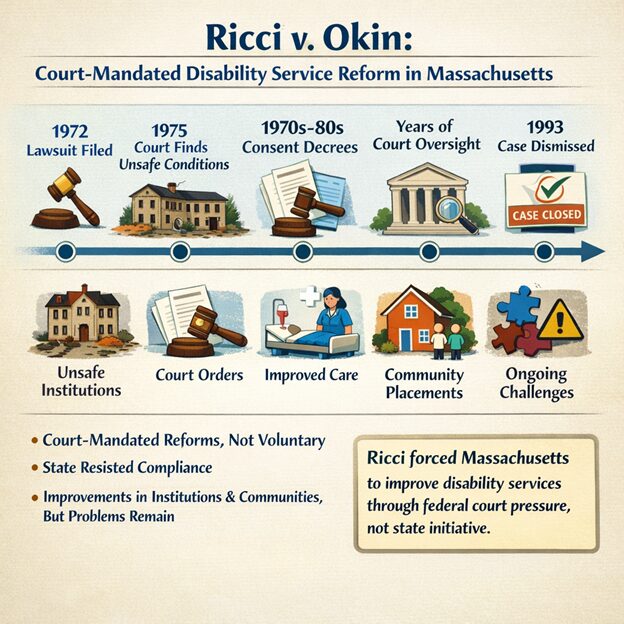
Ricci v. Okin was filed in 1972 on behalf of residents of Belchertown, Fernald, Monson, Wrentham and the state’s other large institutions. The lawsuit documented dangerous and unsanitary living conditions, the absence of medical and dental care, the lack of education and habilitation, severe understaffing, and widespread neglect and abuse.
At that time, Massachusetts placed both mental illness and intellectual disability under the Department of Mental Health, which oversaw the state schools and controlled all placements.
This context matters because families who challenged the system were not simply ignored—they were often punished for speaking out.
The reforms in Ricci were not won easily. Families who challenged the state often faced retaliation. Benjamin Ricci himself described how the Department of Mental Health attempted to transfer his son to an inappropriate psychiatric facility, pressured his employer at UMass, and even forced him to pay tuition for his son’s placement. These were not isolated incidents but part of the climate families confronted when they demanded humane conditions. The progress that followed came from their persistence, not from institutional goodwill.
The Consent Decrees and Decades of Court Oversight
The Ricci litigation did not end with a single ruling. It led to a series of consent decrees — legally binding agreements in which Massachusetts accepted federal court oversight because Judge Joseph L. Tauro of the U.S. District Court had already determined that conditions in the institutions violated residents’ constitutional rights. A consent decree is not a policy recommendation.
It is a court‑enforced plan the state must follow when it cannot defend its own actions.
Why Massachusetts Accepted Federal Oversight
Attorney General Frank X. Bellotti toured Belchertown during the early stages of the case and was reportedly so appalled by what he saw that he told colleagues that the Commonwealth could not defend those conditions in court. His reaction mirrored what many lawmakers experienced when they saw the institutions firsthand. The violations were not abstract — they were visible the moment you walked through the door.
The Commonwealth could not defend what was happening inside its own institutions.
What the Consent Decrees Required
The consent decrees placed Massachusetts under federal supervision for more than twenty years.
Ricci lasted twenty years not because it took twenty years to build a humane system, but because it took twenty years for the federal court to force Massachusetts to comply with orders it repeatedly resisted.
They required the state to:
- rebuild staffing
- provide adequate medical and dental care
- deliver education and habilitation
- ensure safety and sanitation
- develop community residences
- expand community services
- implement individualized planning
- monitor quality of care
These reforms were not voluntary improvements. They were court‑mandated corrections to systemic failures the state had ignored for decades.
The federal courts forced Massachusetts into compliance through binding consent decrees, mandatory staffing orders, personal inspections, injunctions blocking backsliding, the creation of a permanent oversight office, and repeated extensions of court supervision whenever the state failed to meet its obligations.
Ricci required the Commonwealth to provide habilitation not only in the state schools but also in the community. Day Habilitation was supposed to fulfill that obligation. Yet today, many Day Hab programs provide little or no habilitation at all — offering custodial supervision instead of the skill‑building, therapeutic supports, and structured programming the law requires. In this sense, Massachusetts has recreated the very problem Ricci sought to fix: a system that meets its obligations on paper but not in practice.
The End of the Case — and What It Really Meant
When the court finally dismissed Ricci in 1993, Judge Joseph Tauro declared that Massachusetts was “second to none in the world” in the care of individuals with intellectual disabilities. But this praise reflected what the lawsuit had forced the state to build — not a history of independent leadership. Massachusetts became “second to none” because the court required it to, not because the state chose to invest in high‑quality care on its own.
Why the State Rewrote the Story of Its Institutional Past
For decades, Massachusetts has framed the horrors of its institutional past as the inevitable result of “congregate care,” but that narrative obscures a more uncomfortable truth.
The conditions exposed in Ricci were not caused by the size of the buildings or the fact that people lived together.
They were the result of state‑sponsored neglect.
Acknowledging this would have required the Commonwealth to confront its own decisions — the budget cuts, the understaffing, the lack of oversight, and the political indifference that allowed human beings to be left in degrading conditions that no civilized society would accept.
Blaming the model of care was far easier than admitting that the real failure was the state’s abandonment of its responsibility.
This narrative also obscured the federal government’s own role — decades of Medicaid underinvestment in habilitative services, weak enforcement of federal standards, and a funding structure that incentivized institutionalization while allowing states to operate facilities far below acceptable conditions.
To sustain this deflective narrative, state and federal agencies elevated the disability organizations whose messaging aligned with it.
Sidebar: The Chafee Bill (1982)
In the early 1980s, Senator John Chafee introduced federal legislation that would have phased out all large state‑run institutions for people with intellectual and developmental disabilities by cutting off federal Medicaid funding.
The national Arc strongly supported the bill, but families in many states—especially Massachusetts—opposed it because the community system was not yet capable of supporting people with high‑acuity needs.
When the statewide Arc of Massachusetts voted to support the bill, the family associations at the state schools (the facility Arcs) broke away and formed COFAR.
Although the Chafee bill never passed, it triggered a permanent split in the advocacy movement and accelerated the shift toward a provider‑dominated system.

How Government Elevated the Organizations That Echoed Its Narrative
State policymakers did not merely promote the narrative that “congregate care caused the horrors” — they amplified it by elevating and rewarding the organizations that repeated it.
Throughout the 1980s, 1990s, and beyond, lawmakers and state and federal agencies elevated disability organizations that reinforced their preferred narrative—that the horrors inside the institutions were caused by the congregate model itself, not by decades of state neglect or federal underinvestment. These organizations were given disproportionate access, funding, and policymaking influence, and the effect was to amplify a narrative that shifted attention away from governmental responsibility and toward the physical setting of care. In theory, these organizations were expected to represent the full spectrum of people with intellectual and developmental disabilities. In practice, many abandoned that responsibility, promoting a simplified story in which closing institutions—rather than adequately funding and overseeing services—became the primary measure of progress. This alignment of interests reshaped disability policy for decades, often at the expense of individuals with the highest needs.
Sidebar: What Closure Feels Like to the People Being Moved
(Based on reporting by John Hirschauer in City Journal)
The policy debate around institutional closure often ignores the people most affected by it. Alma, a longtime resident of the Polk Center in Pennsylvania, understood what was happening when staff told her she had to move — but she did not want to leave her home. As residents around her were relocated, she cried for days, asking staff, “How would you feel if this was you?”
Some residents weren’t even told Polk was closing. One staff member recalled residents being “loaded into a van” and told they were going on a trip, while another van carrying their belongings left 45 minutes later.
When Alma’s turn came, she bargained to stay. “I will be good,” she said. But she was placed in a van and driven nearly four hours away to another facility. As staff said their goodbyes, Alma cried out from her wheelchair, “Please, give me one more chance.”
Stories like Alma’s reveal the human cost of closure — the loss of home, community, and stability for people who cannot advocate for themselves.
By aligning themselves with the state’s preferred storyline, these disability organizations were invited into advisory councils, consulted on legislation, and treated as the authoritative voice of disability advocacy. This reward structure ensured that the state’s deflective narrative was amplified, normalized, and ultimately embedded in policy, while voices that challenged the state’s culpability — especially families of high‑acuity individuals — were sidelined.
How the Narrative Drove the Closure of Improved ICF/IID Facilities
Once the state’s preferred narrative took hold — that the problem was “congregate care” rather than decades of governmental neglect — it became the justification for dismantling the very ICF/IID facilities that had been improved under federal oversight. Disability organizations elevated by policymakers reinforced the message that closing institutions was synonymous with progress, even when many of those institutions — including those in Massachusetts transformed under the Ricci reforms and others improved nationwide through federal ICF/IID standards — had become clinically appropriate, federally regulated programs.
This narrative allowed the state to close ICF/IID facilities without building an equivalent level of care in the community. It also enabled policymakers to frame the elimination of ICF/IID capacity as a civil‑rights victory rather than a cost‑driven policy choice. Families who relied on these settings — and who understood the clinical and habilitative services they provided — were marginalized in the process. The result was a system in which the most medically complex individuals were left with no viable alternative except nursing homes, psychiatric hospitals, or unstable community placements that could not meet their needs.
This makes it all the more important to return to what Ricci actually showed about the state’s commitment because the historical record tells a very different story from the one later promoted.
What Ricci Actually Shows About the State’s Commitment
1. The state did not improve institutions voluntarily
The horrific conditions documented in Ricci were not unknown to the state. Families, advocates, and staff had been raising alarms for years.
Massachusetts acted only when:
- A federal lawsuit was filed
- The court found constitutional violations
- The court imposed mandatory reforms
This is not evidence of leadership. It is evidence of forced compliance.
2. Community development was court‑ordered, not self‑initiated
The consent decrees required the state to:
- Develop community residences
- Move people into less restrictive settings
- Provide habilitation outside institutions
These were not policy choices. They were legal obligations imposed after the court found the state had violated residents’ rights.
3. The state resisted compliance for decades
Ricci remained active for more than 20 years because the state repeatedly failed to meet the court’s requirements.
The court issued:
- Monitoring reports
- Compliance orders
- Corrective action plans
This pattern mirrors what later happened in Rolland: Massachusetts complies only when watched.
4. Ricci did not eliminate the need for institutional care
Even as the state expanded community services under court order, it continued to operate ICF/IID facilities for individuals whose needs could not be met elsewhere.
This is important because it shows:
- The state has always relied on ICF/IID care for high‑acuity individuals
- Community living was never universally appropriate
- The continuum of care was necessary, not optional
This directly contradicts the state’s current “community‑only” narrative. However, it is important to note that even though ICF/IID care existed and the Commonwealth relied on it, families were systematically prevented from accessing it.
5. Ricci did not fix the broader system
Ricci improved conditions in state institutions and expanded community services, but it did not address:
- Quality of private group homes
- Home and Community-Based Services (HCBS) adequacy
- Staffing shortages
- Oversight of private providers
- The absence of active treatment in community settings
Many of the systemic problems Ricci exposed simply reappeared in different parts of the system.
The Larger Truth: Reform Was Court‑Driven, Not Value‑Driven
Ricci is often remembered as a turning point in disability services, and it was. But the turning point came because the federal court forced it, not because the state embraced a vision of community living.
The pattern is unmistakable:
- The state ignored problems until sued
- The court found violations
- The court imposed reforms
- The state resisted
- The court monitored for decades
- The state complied only under pressure
This is not the behavior of a state with a deep, principled commitment to community living.
It is the behavior of a state that responds to litigation, not to need.
Ricci, like Rolland, is not a story of leadership.
It is a story of forced reform, and a reminder that Massachusetts’ public narrative about community living has never matched its actual record.
Further Reading
For readers who want to explore the history behind the Ricci lawsuit in greater depth, several powerful and accessible books are available through public libraries and bookstores:
Grenon, Ingrid, From One Century to the Next: The History of the Wrentham State School and the Institutional Model in Massachusetts
- Ingrid Grenon’s historical work on Massachusetts institutions traces their origins, evolution, and the systemic failures that shaped them.
Ricci, Benjamin, Crimes Against Humanity: A Historical Perspective
- Benjamin Ricci’s Crimes Against Humanity is a firsthand account of the lawsuit and the conditions that led to it, written by the father who helped expose the truth.
Orzechowski, Ed, “You’ll like it here.” The Story of Donald Vitkus Belchertown Patient #3304
Orzechowski, Ed, Becoming Darlene, The Story of Belchertown Patient #4952
- Ed Orzechowski’s books document personal stories from inside the institutions and preserve the voices of people who lived through this era.
These works offer essential context for understanding how the system developed, why the Ricci case mattered, and how its legacy continues to shape policy and public perception today.
What Comes Next
A 1993 Boston Globe article details Mary Ann Boulet’s challenges caring for her 35-year-old son, Edmund, especially during his frequent seizures. Frustrated by the state’s lack of support, Boulet’s experience led to the Boulet Lawsuit, which will be discussed next in our series.
Previous Installments
To read or listen to the Introduction to our MA IDD Lawsuit series, Introduction: “Why Massachusetts Keeps Getting Sued Over Disability Services,” click here.
To read or listen to Part 1 of our series, “What the Rolland Lawsuit Reveals About Massachusetts’ Real Commitment to Community Living,” click here.
Join the Saving Wrentham and Hogan Alliance today
We’re building a coalition to protect choice, dignity, and high-acuity care for individuals with intellectual and developmental disabilities. As we deepen our advocacy and prepare for next steps, your voice matters more than ever.